
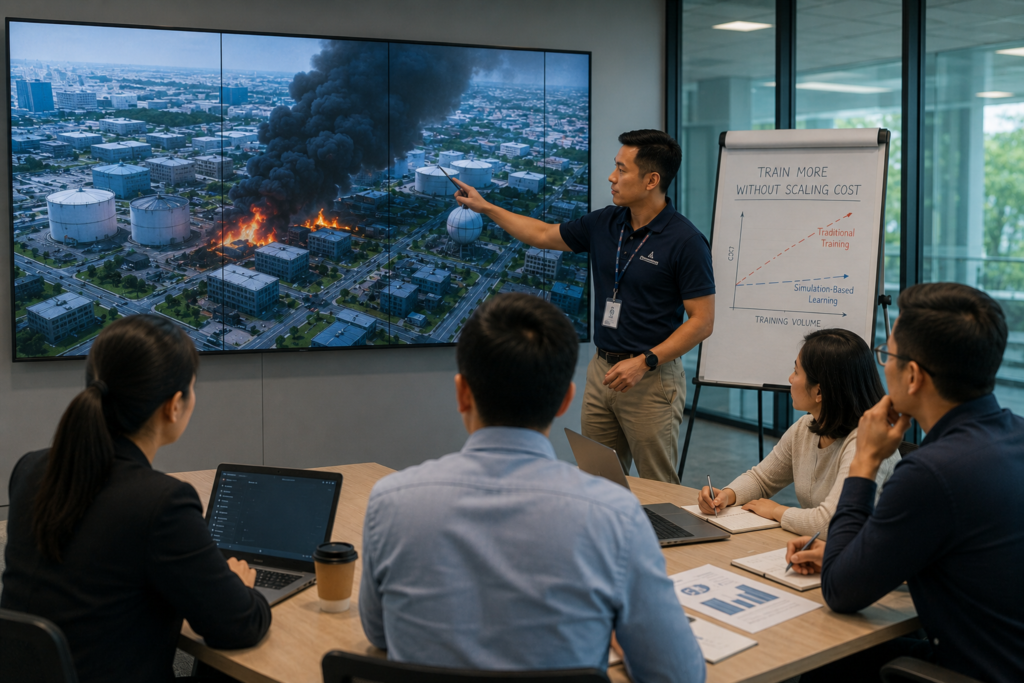
Across emergency services, civil defence, firefighting, and crisis management organisations, one challenge continues to grow: training demands are increasing, but budgets, manpower, and operational availability remain limited.
Leaders are expected to prepare their teams for increasingly complex incidents, from industrial accidents and hazardous materials releases to extreme weather events and multi-agency emergencies. Yet every additional live exercise requires planning, facilities, equipment, instructors, and operational resources.
The result is a difficult balancing act: how do organisations increase preparedness without increasing costs at the same rate?
Simulation-based learning is emerging as one of the most effective answers.
A Challenge Shared Around the World
Whether in Singapore, the United States, or elsewhere, emergency management agencies face the same reality: readiness depends on practice, but large-scale exercises are resource intensive.
The U.S. Federal Emergency Management Agency (FEMA), through its Homeland Security Exercise and Evaluation Program (HSEEP) doctrine, recognises that modelling and simulation can bring "versatility, cost savings, and fidelity to exercises" when incorporated into scenario development and overall exercise design.
In Singapore, simulation has become an established part of emergency preparedness. In 2014, Coventry University Enterprises Ltd was awarded the contract to deliver the Advanced Command Training System 2 (ACTS2) for the Singapore Civil Defence Force (SCDF). Commissioned at the end of 2016 and built using XVR simulation software, ACTS2 provides a realistic virtual environment where commanders can train for complex incidents, including oil refinery fires, marine fires and hazardous materials emergencies, which are difficult to practise frequently through conventional exercises.
Moving Beyond the Limits of Traditional Training
Traditional exercises remain essential. There is no substitute for hands-on experience with equipment, procedures, and operational coordination.
However, traditional exercises often scale linearly with cost.
More participants typically require more instructors, more logistics, more equipment, and more disruption to normal operations.
Simulation offers a different approach.
By creating virtual environments that can be reused, adapted, and repeated, organisations can increase training opportunities without recreating every exercise from scratch.
Train More Frequently Without Rebuilding Every Scenario
One of the greatest strengths of simulation is repeatability.
A hazardous materials incident, refinery fire, flood response, or mass-casualty event can be exercised multiple times, with different variables, without requiring a physical setup for each iteration.
Home Team Academy (HTA) applies this approach through its Home Team Simulation System (HTS2), housed at the Centre for Home Team Simulation, which allows real-world incidents from anywhere to be rapidly adapted into training scenarios. This strengthens the connection between operational experience and training, enabling organisations to revisit scenarios, evaluate decisions, and continually improve capability.
This means organisations can spend less time rebuilding exercises and more time learning from them.
Prepare Teams for High-Risk, Low-Frequency Events
Many of the incidents that matter most happen the least.
Major industrial fires, large scale evacuations, chemical spills and complex multi-agency emergencies may occur only rarely, but responders must be prepared to manage them effectively when they do.
Simulation allows organisations to train for these high consequence events repeatedly without waiting for them to occur or recreating them physically. Teams can rehearse complex scenarios, evaluate different decisions and build confidence in a safe, controlled environment.
In Singapore, this approach has been adopted across emergency preparedness. The Singapore Civil Defence Force uses the Advanced Command Training System 2 (ACTS2) to strengthen commanders' decision making during complex incidents. Building on this capability, Home Team Academy's Home Team Simulation System (HTS2) brings together commanders from agencies including the Singapore Civil Defence Force, Singapore Police Force and Immigration & Checkpoints Authority to practise joint incident management and strategic decision making in realistic simulation environments.
The value goes beyond repeating procedures. Simulation develops judgement, situational awareness, communication and decision making under pressure, helping teams prepare for incidents that are too dangerous, disruptive or infrequent to practise through conventional training alone.
Standardize Training Across Teams and Locations
Maintaining consistent training quality across multiple departments, stations, or jurisdictions is another common challenge.
Simulation platforms allow organisations to deliver standardised scenarios, learning objectives, and performance criteria regardless of location.
This consistency becomes increasingly important as organisations grow or operate across multiple regions.
Home Team Academy runs specialised simulation training programmes that equip officers to be effective facilitators, trainers, and exercise specialists, helping maintain consistency in simulation-based training across different agencies and training teams.
Rather than relying on individual experience alone, organisations can create a structured and repeatable approach to capability development.
Simulation as a Force Multiplier
The purpose of simulation is not to replace live exercises.
Instead, simulation acts as a force multiplier.
Routine decision-making drills, incident command exercises, crisis communication scenarios, and multi-agency coordination activities can be conducted more frequently through simulation, allowing live exercises to focus on objectives that genuinely require physical deployment.
This blended approach is already being adopted by leading emergency services in Singapore, where ACTS2 and HTS2 reflect a broader recognition that realistic scenario-based learning complements traditional training while strengthening organisational readiness.
Training Smarter for the Future
Preparedness is not measured by how many exercises an organisation conduct. It is measured by how effectively people perform when a real incident occurs.
As operational environments become more complex and resources remain constrained, organisations need training approaches that are scalable, repeatable, and capable of supporting continuous improvement.
The experience of organisations such as Home Team Academy and Singapore Civil Defence Force, together with FEMA's guidance on exercise design, points to the same conclusion: simulation enables organisations to increase training opportunities, strengthen decision making and improve organisational readiness while making better use of available resources.
The question is no longer:
"Can we afford simulation?"
The more relevant question may be:
"Can we afford not to scale training smarter?"